

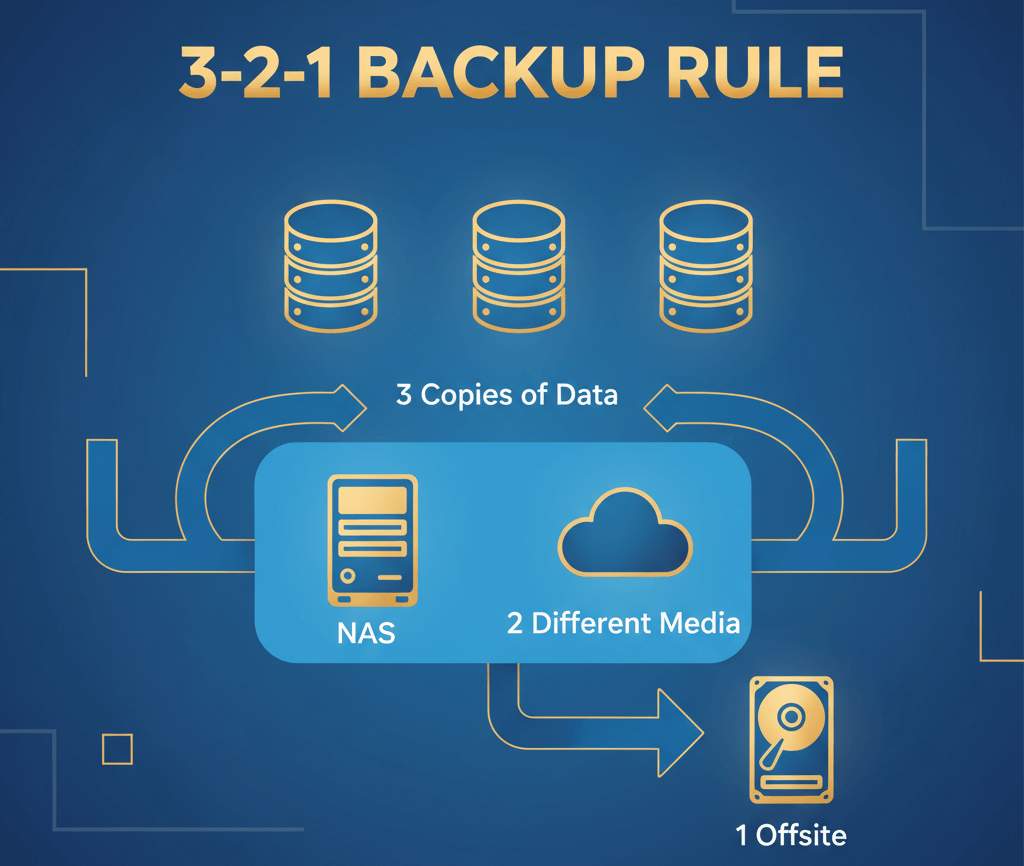
What Is the 3-2-1 Backup Rule?
The 3-2-1 backup rule is a simple, proven framework for protecting your business data against loss: keep three copies of your data, store them on two different types of media, and keep one copy off-site. The three copies mean your live data plus at least two backups. The two media types prevent a single technology failure from wiping out everything. The one off-site copy protects you from fire, theft, flood, or ransomware that reaches your local network. If one copy is corrupted or fails, you always have another to recover from. For an Alberta SMB, it is the foundation of any workable disaster recovery plan — and the right managed backup and security partner can set it up and test it so recovery actually works when you need it.
Why Have a Disaster Recovery Plan?
As the person managing IT for an Alberta SMB, you know how heavily daily operations rely on your infrastructure. Customer data, financial systems, communication platforms like VoIP phones – a disruption to any of these can quickly bring business to a halt. Disasters, whether cyberattacks, hardware failures, human errors, or even natural events, are unfortunately a constant threat.
Without a tested IT Disaster Recovery (DR) plan, your business faces significant risks: prolonged downtime, lost revenue, damaged customer trust, and potentially unrecoverable data loss. This isn’t just an enterprise concern; proactive DR planning is vital for SMB resilience. This is Part 2 in our SMB Resiliency Series, focusing on practical steps you can take.
What is IT Disaster Recovery Planning?
Simply put, IT Disaster Recovery planning is the process of creating, documenting, and testing a strategy to restore essential IT operations quickly after a disruption.
The core goals are to:
- Minimize Downtime: Reduce the time critical systems are unavailable.
- Ensure Business Continuity: Allow essential functions to continue during recovery.
- Restore Normal Operations: Bring all IT systems back online efficiently post-disaster.
It’s a key component of a comprehensive IT Risk Management strategy.
The Foundation: The 3-2-1 Backup Rule
One of the most fundamental and effective strategies for data protection within any DR plan is the 3-2-1 rule. It’s a simple framework to significantly reduce the risk of data loss:
- THREE Copies of Your Data: Maintain at least three separate copies of all critical business data. This includes your primary live data and at least two backups. If one copy is corrupted or fails, you have others.
- TWO Different Storage Media: Don’t put all your backups in one basket. Store these copies on at least two distinct types of media. Examples include internal hard drives, external USB drives, Network Attached Storage (NAS) devices, tape drives, or cloud storage platforms. This protects against the failure of a specific type of storage.
- ONE Offsite Backup: Keep at least one of your backup copies physically separate from your primary location. This could be a secure cloud storage provider or physically transporting backup media to another secure site. This is crucial protection against localized disasters like fire, flood, theft, or ransomware that could compromise everything at your main office.
Adhering to the 3-2-1 rule provides a robust defense against most common data loss scenarios.
Practical Tips for Implementing Your DR Plan
Creating a DR plan doesn’t have to be overwhelming.
Focus on these practical steps:
- Identify Critical Systems & Data: What absolutely must be recovered first to keep the business minimally operational? (e.g., email, core business application, customer database). Define your Recovery Time Objectives (RTO – how fast?) and Recovery Point Objectives (RPO – how much data loss is acceptable?) for these critical assets.
- Assign Responsibility (DR Champion/Team): Designate a specific person or small team responsible for overseeing the DR plan’s creation, execution, and testing. Ensure roles are clear. This responsibility can often be effectively managed by your Managed IT Support partner.
- Develop a Communication Plan: How will you communicate with employees, key stakeholders, and possibly customers during a significant IT disruption? Define channels (e.g., backup email, text lists), emergency contacts, and basic messaging templates.
- Document the Plan: Write down the recovery steps clearly and concisely. Include system priorities, backup locations and access methods, key vendor contacts, and team responsibilities. Ensure this plan is accessible even if your primary network is down (e.g., printed copies, cloud storage accessible via personal devices).
- Test Regularly & Update: An untested plan is just a document. Conduct regular tests (at least annually) – ranging from simple file restores to simulated failover scenarios – to verify backups are working and the team knows the procedures. Update the plan whenever significant changes occur in your IT environment or business processes.
Build Resilience Before Disaster Strikes
IT disaster recovery planning is a critical investment in your SMB’s longevity. By implementing a clear plan, grounded in principles like the 3-2-1 rule, you equip your business to navigate disruptions effectively, protecting your valuable data and ensuring continuity.
Your Path to Business Continuity
Ready to build a robust Disaster Recovery plan tailored for your Alberta SMB? At Next Step TSP, we guide you through a simple, clear process:
STEP 1: Schedule Your Free Technology Assessment
We’ll start with a conversation focused on understanding your business, its critical systems, and current backup/recovery processes. Then, we’ll identify your biggest frustrations or vulnerabilities and pinpoint opportunities for improved resilience and potential savings.
STEP 2: Get a Customized Plan
We’ll provide a clear, Tech Jargon-free plan outlining a DR strategy, incorporating the 3-2-1 rule and defining RTO/RPOs, designed to protect your data, minimize downtime, and ensure business continuity.
STEP 3: Eliminate Tech Stress for Good
We’ll execute the plan, implementing robust backup solutions and documenting recovery procedures, becoming your single point of contact so you can focus on your business with peace of mind.
Don't wait for a crisis to discover gaps in your recovery plan.
OR
Frequently Asked Questions: Data Backup & Disaster Recovery
Why isn’t one cloud backup enough?
A single backup is a single point of failure. If that copy is corrupted, silently fails, or gets encrypted by ransomware that reaches your connected cloud storage, you have nothing to fall back on. The 3-2-1 rule deliberately spreads your data across copies, media types, and locations so no single event can take out every copy at once.
What counts as "two different media types"?
Two distinct kinds of storage — for example, an on-site network device (NAS or server) plus a cloud backup, or local disk plus immutable cloud storage. The goal is that a failure mode affecting one type (a drive failure, a cloud account compromise) does not also destroy the other.
How often should we test our backups?
Regularly — a backup you have never restored from is only a hope, not a plan. At minimum, test a full restore quarterly and after any major system change. Testing is where most SMBs discover gaps (missing data, broken restore steps) while it is still safe to fix them, rather than during a real outage.
Isn’t disaster recovery only an enterprise concern?
No. Smaller businesses are often more exposed, because a few days of downtime or a permanent data loss can be existential. The 3-2-1 rule scales down cleanly and affordably, giving an Alberta SMB the same core resilience a larger firm relies on without an enterprise budget.