
What Is Business Resilience for an Alberta SMB?
Business resilience is a business’s ability to keep operating through disruption — and recover quickly afterward — built on three connected disciplines: IT risk management, governance, and disaster recovery. Risk management identifies and reduces what could go wrong; governance sets the policies and accountability that keep security consistent; and disaster recovery is the tested plan to restore operations when something does fail. For Alberta SMBs facing rising costs, labour shortages, and AI-powered threats, resilience isn’t a large-enterprise luxury — it’s survival. The shift that matters is moving from a reactive “break-fix” habit to a proactive strategy, and a managed security and IT partner can build and maintain that framework with you.
Making Your Alberta SMB Resilient
Managing IT for an Alberta Small or Medium-sized Business (SMB) means juggling constant demands. Keeping systems running, users happy, and budgets in check leaves little time for complex topics like Risk Management, Governance, and Disaster Recovery (DR). It’s easy to think these are concerns only for large corporations.
That thinking is no longer safe. The reality is cyber threats, now often powered by AI, target businesses of all sizes. Operational disruptions, whether from hardware failure or a ransomware attack, can be cripplingly expensive. For Alberta SMBs facing rising costs and labour shortages, business resilience isn’t a luxury; it’s essential. Moving beyond a reactive, “break-fix” IT approach to a proactive strategy is key to survival and growth.
This guide provides a practical framework for building that proactive strategy. We’ll demystify IT Risk Management, Governance, and Disaster Recovery, showing how integrating these components protects your operations, ensures stability, and transforms your technology from a potential liability into your greatest asset.
 IT Risk Management: Identify and Control Threats
What it is: IT Risk Management is the ongoing process of identifying potential threats to your company’s technology and data, understanding the business impact if those threats occur, and implementing sensible controls to minimize that risk. It’s about looking ahead, not just reacting to crises.
Common Threats Facing Alberta SMBs:
- Cyberattacks: Ransomware, phishing emails designed to steal credentials, malware infections.
- Hardware Failure: Aging servers, failing hard drives, network equipment malfunctions.
- Software Issues: Unpatched vulnerabilities, software conflicts, corrupted data.
- Human Error: Accidental data deletion, clicking malicious links, misconfigurations.
- Environmental Factors: Power outages, floods, fires impacting physical infrastructure.
The Risk Assessment Process:
- Know Your Critical Assets: What technology and data are essential for operation? (e.g., Customer database, financial software, email server).
- Identify Realistic Threats: Which common threats are most likely to affect your assets?
- Spot Your Vulnerabilities: Where are your current weak spots? (e.g., No regular offsite backups? Lack of security training?).
- Assess the Business Impact: What’s the real cost if a threat occurs? (Lost revenue per hour, recovery costs, fines (PIPA), reputation damage).
- Prioritize: Address risks with the highest likelihood and most severe impact first.
Choosing How to Treat Risks:
- Mitigate: Implement controls – firewalls, multi-factor authentication, staff training – to reduce risk. (This is key).
- Transfer: Use insurance or outsource specific high-risk functions.
- Avoid: Change processes to eliminate the risk.
- Accept: For low-impact/low-likelihood risks, formally accept it (and document why).
Regularly reviewing risks keeps your defences relevant. For a more focused look at why this process is critical in today’s threat landscape, see our guide on .
📜 IT Governance: Establishing Clear Rules for Technology
What it is: IT Governance creates the policies, procedures, and accountability framework for how technology is acquired, used, secured, and managed within your company. It ensures IT activities support business goals and comply with regulations. For SMBs, it’s about practical rules, not excessive red tape.
Why IT Governance Matters for Your SMB:
- Consistency & Security: Ensures everyone follows secure practices.
- Compliance: Helps meet legal requirements like Alberta’s PIPA.
- Better Decisions: Provides a framework for evaluating IT investments.
- Clarity: Defines who is responsible for IT security and management.
Basic & Essential Governance Policies for SMBs:
- Acceptable Use Policy (AUP): Guidelines for using company tech securely.
- Data Security & Privacy Policy: How you handle sensitive data (PIPA compliance).
- Password Policy: Mandate strong passwords and Multi-Factor Authentication (MFA).
- Backup & Recovery Policy: Formalize backup schedule, storage, testing.
- Basic Incident Response Outline: Who to contact and initial steps during a security breach or outage.
Simple, clear governance provides structure to manage risks. Developing robust is a key step in building this structure.
 Disaster Recovery (DR) for Business Continuity
What it is: Disaster Recovery focuses specifically on how to restore your essential IT systems and data after a major disruptive event (fire, flood, cyberattack, critical hardware failure) to minimize business interruption.
Why DR is Crucial for SMBs:
Extended downtime can be fatal for an SMB. A DR plan minimizes financial losses, protects customer relationships, and ensures operational continuity.
Key DR Concepts:
- Recovery Time Objective (RTO): How fast do systems need to be back online?
- Recovery Point Objective (RPO): How much data can you afford to lose?
Core DR Components:
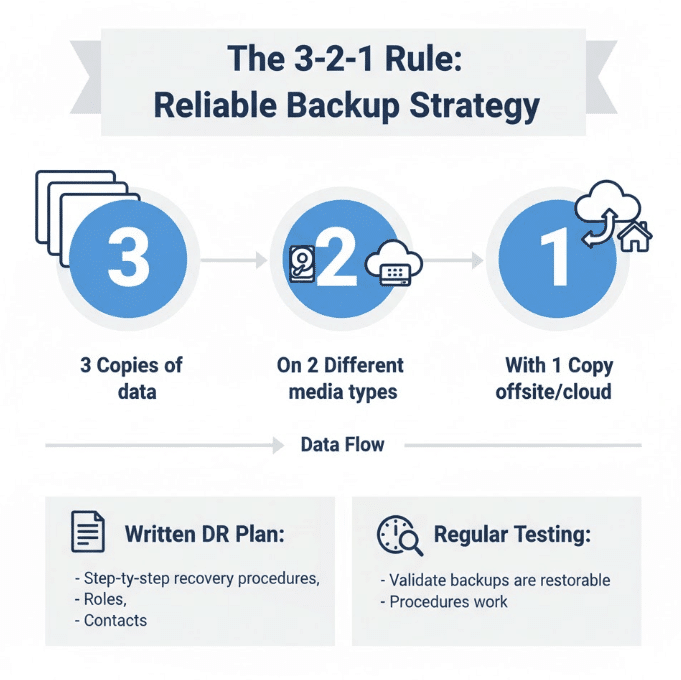
Reliable Backup Strategy (3-2-1 Rule):
- 3 Copies of data.
- On 2 Different media types.
- With 1 Copy stored offsite/cloud.
- Written DR Plan: Step-by-step recovery procedures, roles, contacts.
- Regular Testing: Validate backups are restorable and procedures work.
A well-defined and tested DR plan provides the ultimate safety net, ensuring your business can weather unexpected storms.
 Redundant Internet: A Cornerstone of Resilience
For many Alberta SMBs today, a stable internet connection isn’t just important – it’s the lifeline of the business. Cloud applications, email, VoIP phone systems, payment processing, and remote access all depend on it. What happens if your primary internet provider experiences an outage due to construction, weather, or equipment failure? This downtime translates directly into lost revenue and productivity.
Striving for the "Five Nines"
In the world of IT, the gold standard for reliability is often referred to as “five nines” uptime, which translates to 99.999% availability. Achieving this level means experiencing, on average, less than 5.26 minutes of downtime over an entire year. For businesses heavily reliant on continuous connectivity, minimizing downtime to this level is crucial for maintaining operations and customer trust.
A redundant internet connection (also known as a backup or failover connection) is a primary strategy for achieving near-five nines reliability for your connectivity. This involves having a secondary internet line from a different provider, ideally using a different physical infrastructure (e.g., fibre as primary, high-speed wireless or coax cable as secondary).
Benefits for Your SMB:
Minimizes Costly Downtime: Aiming for five nines significantly reduces the financial impact of outages. A redundant connection can automatically switch over, drastically cutting downtime from hours to mere minutes or seconds annually.
Ensures Business Continuity: Critical operations dependent on the internet can continue uninterrupted, supporting your goal of maximum availability.
Supports Cloud Reliance: Consistent access to essential cloud-based software (like Microsoft 365, CRMs, etc.) is maintained, even during a primary provider issue.
Enhances VoIP Reliability: Achieve higher reliability for your critical voice communications. A failover connection ensures your VoIP phone system stays online.
Implementing a redundant internet strategy is a key component of modern disaster recovery planning and a practical step towards achieving high availability and mitigating significant business risk. As part of our , NSTSP can help design and implement a cost-effective redundancy strategy tailored to help your business strive for maximum uptime.
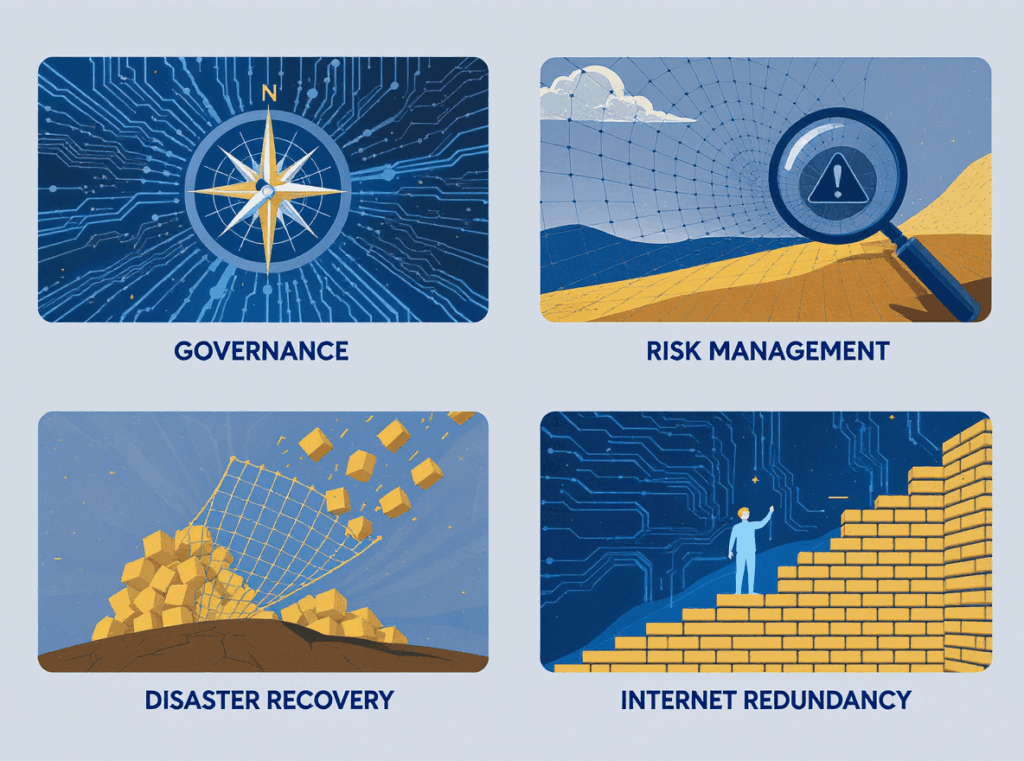
 Integrating IT Risk Management, Governance, DR, and Redundant Internet, is building your business upon a ROCK.
These Four pillars aren’t separate silos; they work together:
- Risk Management identifies the threats you need to protect against.
- IT Governance defines the policies and procedures to mitigate those risks consistently.
- Internet Redundancy allows you to stay up and running so you can execute the plan.
- Disaster Recovery provides the tools to recover if mitigation fails and a risk materializes.
A proactive approach means understanding your risks, setting clear rules (governance) to manage them, and having a tested plan (DR) for when things inevitably go wrong. This holistic strategy moves your IT from a reactive cost centre to a stable, resilient foundation for business operations.
Next Step TSP: Your Guide to Proactive IT Resilience
Implementing a comprehensive Risk Management, Governance, and DR framework can seem daunting. Next Step Technology Solutions Provider specializes in guiding Alberta SMBs through this process. We leverage our Discover, Stabilize, Optimize, Innovate methodology:
- We Discover your specific risks and operational needs.
- We help you Stabilize your environment with foundational security and reliable backups.
- We Optimize your systems and policies for ongoing resilience and efficiency.
- We help you Innovate by ensuring your technology strategy stays ahead of emerging threats and supports future growth.
We provide the expertise and tools—from Cybersecurity to IT Support robust and DR solutions—to build a truly resilient technology foundation.
Your Path to Proactive IT Resilience
Ready to move beyond reactive IT fixes and build a truly resilient business? At Next Step TSP, we guide you through a simple, clear process:
STEP 1: Schedule Your Free Technology Assessment
We’ll start with a conversation focused on understanding your business and its unique technology dependencies and risks. Then, we’ll identify your biggest frustrations and pinpoint opportunities for savings and improved resilience.
STEP 2: Get a Customized Plan
We’ll provide a clear, Tech Jargon-free plan outlining a strategy incorporating Risk Management, Governance, and DR best practices to reduce your exposure, increase stability, and drive business continuity.
STEP 3: Eliminate Tech Stress for Good
We’ll execute the plan, implementing the necessary security controls, backup solutions, and policies, becoming your single point of contact so you can focus on your business with peace of mind
Don't wait for a disaster to test your preparedness
Schedule Your Free Technology Assessment today to start building a more secure and resilient future for your Alberta SMB.
OR
Learn more about Comprehensive Cybersecurity & IT Strategy Services specifically designed to protect and empower your Alberta based Small and Medium Sized business.
Frequently Asked Questions: Business Resilience
How are risk management, governance, and disaster recovery different?
They are three parts of one framework. Risk management is identifying and reducing threats before they hit. Governance is the policies, roles, and accountability that keep security consistent day to day. Disaster recovery is the tested plan for restoring operations after a disruption. You need all three — strong prevention still requires a recovery plan, and a recovery plan still needs governance to stay current.
Isn’t this only a concern for large corporations?
That thinking is no longer safe. Cyber threats — now often AI-powered — target businesses of every size, and an operational disruption can be proportionally more devastating for a smaller firm. For Alberta SMBs already managing rising costs and labour shortages, resilience is what prevents a single incident from becoming an existential one.
What does moving from "break-fix" to "proactive" actually mean?
Break-fix means waiting for something to break and then reacting — paying in downtime and emergencies. Proactive means continuously assessing risk, applying preventive controls, monitoring systems, and testing recovery, so problems are prevented or contained instead of fought in a crisis. It trades unpredictable firefighting for predictable, manageable resilience.
How does an SMB build this without a dedicated security team?
Most don’t build it alone — they partner. A managed provider supplies the framework, tools, and ongoing oversight that an in-house team would, sized and priced for an SMB. That gives a smaller business enterprise-grade resilience across risk, governance, and recovery without hiring for every discipline internally.